
Is Stamped Concrete a Good Choice for Patios in The Colony?
Yes. Stamped concrete is a durable, customizable patio option for homeowners in The Colony, TX, especially when it is professionally installed and regularly sealed. It can recreate the appearance of stone, brick, slate, or wood while providing a solid concrete surface that can last 30 years or more with proper installation and maintenance, according to Concrete Network.
Homeowners considering stamped concrete often have the same questions: Will it crack? Does the color fade? How often does it need sealing? Is it slippery? And, most importantly, will it hold up in North Texas weather? At My New Patio & Fence, we help homeowners in The Colony and throughout Collin and Denton counties create outdoor living spaces designed around their homes, lifestyles, and long-term needs. Stamped concrete is popular because it combines decorative flexibility with the strength and practicality of concrete. The key is getting the installation details right, from site preparation and drainage to finishing, joint placement, coloring, and sealing.
What North Texas Homeowners Should Know About Stamped Concrete
The best stamped concrete patio is not simply the one with the most attractive pattern. Installation quality, maintenance, drainage, surface texture, and design choices all affect how the patio performs over time.
That matters in The Colony, where outdoor surfaces experience significant seasonal temperature changes. Visit The Colony reports average high temperatures around 95°F in July and August, while average January lows fall to about 39°F. A patio should be designed and maintained with those changing conditions in mind.
How Long Does Stamped Concrete Last?
Properly installed and maintained stamped concrete can last 30 years or longer. Concrete Network lists the expected lifespan of maintained stamped concrete at 30-plus years.
Several factors determine whether a patio reaches that lifespan:
- Properly prepared and compacted subgrade
- A concrete mix appropriate for the application
- Good drainage around the slab
- Proper curing after installation
- Correctly planned control joints
- Periodic cleaning and resealing
- Prompt attention to developing damage
Subgrade preparation is particularly important. Concrete Network notes that inadequate preparation beneath residential concrete slabs is a common cause of premature failure. A stable, properly compacted base provides more uniform support and reduces the risk of settlement and cracking.
For homeowners in The Colony, investing in professional preparation is just as important as choosing the right stamp pattern or color.
Does Stamped Concrete Crack?
Stamped concrete can crack because it is still concrete, but proper installation can significantly reduce uncontrolled cracking. Minor cracks may also be less noticeable because textured patterns and joint lines can help disguise them.
Concrete naturally expands and contracts as temperatures and moisture conditions change. Contractors use control joints to encourage shrinkage-related cracking to occur in planned locations rather than randomly across the patio.
Homeowners should ask their contractor about:
- Subgrade preparation
- Reinforcement when appropriate
- Drainage and grading
- Control-joint placement
- Concrete curing procedures
No reputable contractor should promise that exterior concrete will never crack. A better goal is a properly designed slab that manages movement and minimizes the likelihood of noticeable, problematic cracking.
How Often Should Stamped Concrete Be Sealed?
Most stamped concrete should be resealed approximately every two to five years, depending on weather, traffic, exposure, and the sealer used. Concrete Network notes that higher-traffic surfaces and harsher environments may need more frequent attention.
Sealing does more than make stamped concrete look shiny. A quality exterior sealer can help:
- Reduce moisture penetration
- Protect against stains
- Limit abrasion and surface wear
- Enhance decorative colors
- Make routine cleaning easier
- Protect the decorative finish from UV exposure
For a North Texas patio exposed to strong summer sunshine, maintaining the sealer is particularly important for preserving its decorative appearance.
Homeowners do not necessarily need to reseal according to a rigid calendar. If water quickly soaks into the concrete instead of beading on the surface, or the finish looks noticeably dull or faded, it may be time to have the patio evaluated for resealing.
Is Stamped Concrete Slippery When Wet?
Stamped concrete can become slippery when wet, particularly when a smooth texture or glossy film-forming sealer is used, but slip resistance can be improved during installation and sealing.
This deserves extra consideration around pools, outdoor kitchens, steps, and frequently used walkways.
Options for improving traction include choosing a more textured stamp pattern or incorporating a non-slip additive into an appropriate sealer. Concrete Network specifically recommends considering non-skid additives for surfaces such as pool decks and walkways.
Tell your contractor how you plan to use the space before selecting a finish. A beautiful wet-look surface may not be the best choice if traction is your highest priority.
How Much Does Stamped Concrete Cost?
Stamped concrete pricing depends primarily on patio size, site conditions, pattern complexity, colors, borders, and other custom details. As a national reference point, Concrete Network reports 2026 costs of roughly $10 to $14 per square foot for basic stamped concrete, $14 to $20 for mid-range designs, and $20 or more for elaborate installations. Local North Texas quotes can differ substantially.
Basic projects usually use one pattern and one color. Adding contrasting borders, multiple colors, specialty scoring, or detailed hand coloring increases labor and material costs.
Homeowners should therefore compare proposals based on more than the bottom-line price. Ask what is included in site preparation, concrete specifications, decorative work, sealing, and cleanup. A patio designed to perform for decades offers a different value proposition than a quote focused primarily on lowering the initial installation cost.
Frequently Asked Questions About Stamped Concrete
Does stamped concrete color fade?
Stamped concrete can lose some color intensity from UV exposure, weather, traffic, dirt, and worn sealer. Regular cleaning and resealing can minimize these changes, and faded decorative concrete can sometimes be refreshed through professional cleaning and resealing.
Is stamped concrete cheaper than pavers?
It can be, depending on the design. Concrete Network’s 2026 national estimates put basic stamped concrete at about $10 to $14 per square foot, but elaborate multi-pattern and multi-color installations can cost $20 per square foot or more.
Is stamped concrete difficult to maintain?
No. Routine maintenance generally consists of keeping the surface clean, dealing with spills promptly, and periodically resealing it. The exact resealing interval depends on traffic, weather exposure, and the sealer system.
Can stamped concrete look like natural stone?
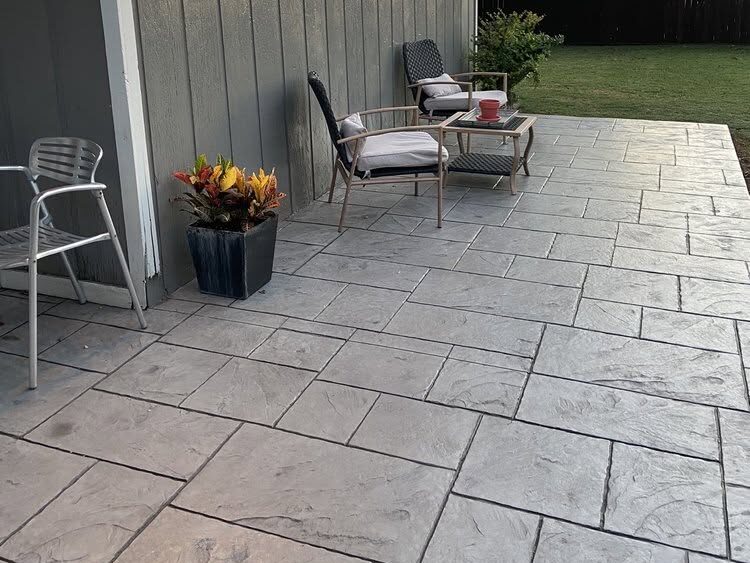
Yes. Stamped concrete can reproduce patterns inspired by slate, flagstone, cobblestone, brick, and other materials, while different colors and antiquing techniques can add depth and variation.
Ready for a Stamped Concrete Patio in The Colony?
Stamped concrete can be an excellent choice when you want the durability of concrete with more flexibility in pattern, texture, and color. For homeowners in The Colony, Collin County, and Denton County, the best results start with thoughtful design, proper site preparation, professional installation, and a realistic maintenance plan.
Ready to transform your backyard with stamped concrete? Contact My New Patio & Fence to start planning your outdoor space.